I'm falling behind on these posts. I feel awful about that.
Sunday: The time change killed me. I got up, changed into sweat pants (I never wear sweat pants) and then went down into the basement and just watched movies. I went to the gym later in the evening but managed a measly 5 miles. That was it. Ugg. I was so dead. Zombified even.
But on the upside, the COSMOS reboot aired. For those of you out of the loop, Cosmos was a scientific/space program that aired in the 80s and was hosted by the late Dr. Carl Sagan. Dr. Sagan was one of the greatest science advocate in twentieth century. The new series is a n update with better CGI and all of the new information that we've learned in the last 30 or so years. The new show is hosted by the only person who would be even close to filling in for Dr. Sagan- Dr. Neil de Grasse Tyson. Look them up if you want to learn more about them. Cosmos was the highlight of my day. It was beautiful, both in it's scope, the imagery, and the teachings, but also the fact that the premiere aired on 10 fox networks simultaneously. FOX! As in the Fox News corporation! And here it is airing a show about the creation of the universe and our place in the cosmos.
Why am I talking about it in a running blog? Because it is one of the things that I love to think about while I run- our purpose and our place. The beauty we see around us is all from one singular point yet we are living in this exact frame, this snap shot and blink of an eye. Everything around us has only come to be in the last fraction of a second of the last minute of the cosmic calendar. Yet we have the capacity to find enjoyment in this fraction, on a lonely spec of dust; to us it is all we have and know. And running allows me to embrace that sense of awe and wonder- the experience of ourselves.
Needless to say that I nerded out so damn hard the entire hour it was on...
Miles today: 5
TOTAL: 138.3
Day 10: Track Monday!
Monday went a lot better than Sunday. I felt a lot more fresh and the day was pretty awesome. I got to Campus a little bit before 8, went to the indoor track and started to run. I was meeting my friend James there at 8:30 so I had some time to kill before my workout with him so I decided to get into a really decent distance effort as well as the speed we were going to do. So I warmed up, did another 5k tempo (just south of 18minutes), cooled down slightly and then did some ins and outs. An in-and-out is where you are almost tapping the gas pedal for a bit (say, 120m) then coasting at a decent pace for 120m. When James showed up we ended up doing some speedier stuff-
set 1): 200,300,300,100,100- 20-25" between intervals
rest: walk/jog l lap
Set 2): 200,300,300,100,100- 20-25" between intervals
rest: walk/jog 1 lap
Set 3) 100,400,400,100- 20-25" between intervals
Cool down
I hadn't done speed in i don't know how long so it was great. They were decently quick and I felt pretty good at the end. But my poor calves. Indoors and calves do not get along very well. I'm pretty sure there were words said long ago which started some sort of blood feud between the two that has been raging for eons.
I sat around feeling sorry for my calves most of the evening then decided to just get a run over with before bed. a nice 8 miler in the dark.
But it was finally above 0 degrees at night! WHAT? Are we still in Canada?
Today: 17.2 miles
TOTAL: 155.5 miles/500
Showing posts with label running shoes. Show all posts
Tuesday, March 11, 2014
Wednesday, August 21, 2013
"What is this Trail Stuff anyway": Shoe Review: Salomon S-Lab SENSE
Trail folk are a different breed. They seem to take enjoyment in doing silly things like running 100km or an ungodly sum of miles as a race. They pass off 50km on single track trail with technical climbs that have you crawling up hand-over hand as if it were just a gentle day in the park (I will probably get yelled at by said trail folk because they claim it is a lot more difficult than that, but I stand by my bias). They prance like graceful deer along through the forest, infuriatingly so, that of course I had to do something about it.
When asked about what shoes are the "best" for running trail (what brand should I look at), you'll get a vehemently definite but different answer from every serious trail runner. They stick to their guns. One that had always piqued my interest was Salomon. I mean, come on, I don't want to be running in skis here; they make shoes? Yet, after Carl and I had done some more in-depth research, we learned that Salomon in fact does make shoes and heck, they make some pretty slick ones at that. So of course we had to go out and see for ourselves just what the hubbub was about. This seems like a long build up to get into a pair of shoes right? Well yes, but it's fun and the allure of fluffy writing is oft at times too great to pass up. And with that out of the way, on to the review.
| Please note the dirt and fading of the white- I have done some serious trailing in these puppies. |
The Salomon that I had to get my hands on were these new S-Lab Sense, Salomon's high performance shoes (my inflated opinion of myself obviously makes me think of myself as being the highest of performance) made with Kilian Jornet, the Western States Endurance Run 2011 Champion. These are pretty wild. Having never stepped foot into the mythical realm of trail and ultra running (I still think cross country is way out there), I didn't know what to expect. (If you are looking for a more durable and sensible trail shoe from the Sense Family, check out the new Mantra).
Coming in at just 7oz the S-Lab Sense is one of the lightest shoes I've ever run in. I had always expected trail shoes to be heavy because of all the tough rubber and protective uppers that so commonly grace these types of shoes. But these things are light. There's very little to them in terms of an upper and big thick lugs. The S-Lab Sense, like all Salomon shoes, uses Salomon's speed laces which help to keep the foot snug and fixed in the shoe very well as well as keeping the weight down. The Sense also sports what Salomon has dubbed ENDOFIT. The upper is all seamless and the tongue is attached to the sole via stretchy mesh which creates a very sock-like fit within the shoe. The S-Lab Sense won't be moving around at all while you're foot's in there that's for sure. And with the seamless upper it is very comfortable, so much so that a guy like me who likes to wear socks in my Nike Victory spikes actually felt pretty comfortable going sockless in the Sense. The upper is made of very thin mesh which means the shoe moves and breathes very well while on your foot, aiding performance greatly in muddy and rainy conditions to prevent water logged feet.
These shoes are built for speed in mind. Heel (13mm) to toe (9mm) drop is a low 4mm, and helps give the under foot impression that these are very much the trail version of a track or road racing flat. And along the bottom we also see some evidence that these aren't exactly your typical trail shoe and that they are built with the sole purpose of running fast, not necessarily with heavy trail in mind.
The bottoms are pretty flat for a trail shoe (and even a road shoe for that matter). The lugs are almost non-existent and very minimal. You can tell the shoe is meant for forefoot striking based on the location of the lugs and where Salomon has placed their new PROFEEL FILM, a thin layer of carbon along the forefoot, strething into the midsole.
Now for my qualms with the Sense. This is an expensive shoe. Coming in at $200 it is more pricy than a lot of the other racing shoes on the market today. That's not to say that it's not worth it; this ultra light racer is packed to the brim with new and cool technologies and tons of fun little nuances that make the Sense stand out in a crowd. I also find it odd that for being a trail shoe the lugs seem to be a bit of an after thought. True, they have dynamic lug placement meaning that the lugs are offset in certain places to allow better grip going up, down, sideways, long ways and whatever other ways you can think of. But I just don't see them being useful in very wet, technical terrain or especially over wet grass where you'll be sliding all over the place. These are great if you are going fast over packed, single track dirt paths or a little loose or through some straight muddy sections where you need something light that dries fast. One of the other issues I found what that the landing is very stiff or hard. The shoe itself is very flexible and responsive, but if I ever went on the road with the Sense I found the shoe made for a just a little bit too stiff of a landing. Road transition proved to be a bit of a no-no. The only other issue I could see with prolonged future use of the Sense is the durability. Being as light and as minimal as they are, I could see heavy trail use (like some of the serious trail nuts put their shoes through) could cause the shoes wear out slightly quicker than some of the heavy, built-up shoes.
In conclusion, if you are looking for a light, comfortable, forefoot trail shoe for doing some serious speed work on soft surfaces but aren't afraid of spending a little more, the S-Lab Sense is a great shoe to try out. It may not be your typical trail shoe, and I think it's more inspired by racing flats from the road as opposed to the heavy trail grinders, but the Sense sure is fun. As always, if you have any questions about these or any of the other shoes Runner's Mark carries, let me know! If you just like to talk running and the sport in general, shoot me an e-mail and I'll be more than happy to talk with you.
For our Men's Salomon Selection.
For out Women's Salomon Selection
~E
@runners_mark
facebook.com/runnersmark
Tuesday, August 6, 2013
Shoe Review: The ALTRA Samson/ Delilah
I had never seen an Altra shoe prior to walking into the store. They have an oddly wide toe box and were designed to be fully "zero drop" meaning the heel to toe offset was just that: zero. Having been so used to the industry standard of shoes coming to a narrow, pointed toe, the Altra presented itself as an odd creature. At first I flat out didn't like it. It was too odd looking with the wide toe box in stark contrast to what the industry standard is. I've run in zero drop, minimal shoes before (the minimus zeros) and was fine with that, but aesthetic was just... no. But like any intrepid young runner, my curiosity got the best of me. I just had to see what they were all about. And I'm glad I did.
Weight: 6.5 0z
Drop: 0
Midsole: 3.4mm Razor-Siped Performance Rubber BareSole
Outsole: 3.5mm EVA
Although I initially looked at my feet in these odd-looking shoes with more than a little trepidation, I now see them as possibly the most comfortable shoes I've ever worn. The wide toe box may turn off some at first glace but I implore you to try it. It allows your toes to fully splay in a more natural movement, which I find helps even with basic blisters and preventing blackened toe nails. It should be noted that I am not a barefoot running enthusiast. I don't have any burning desires of getting connected with the ground or having the oft delusional view that running barefoot is the key to being injury free. BUT I do know that running barefoot and training with minimal shoes is a great tool to build minute muscle strength in the foot and ankle and correct poor running form/posture. Having your toes splay helps greatly with balance and posture by distributing your weight throughout your foot and especially your big toe (where most of your foot balance comes from). I can't tell you enough how much I like the wide toe box. It is just so roomy and comfortable while walking or running that I'm surprised I put up with other things for so long. And not only that but the shoe's aesthetics have grown on me as well. Once they are on your feet they actually look pretty good. I don't know if it is because it looks closer to your own foot shape and there is some primordial, ingrained perception that our feet are supposed to look a certain way and we subconsciously love it when we can see our own foot shape (have to throw some stuff in for those of us who are more inclined to conspiracy theories). Even my mother, who saw them just as I did at first, weird looking and different, now wants a pair after seeing them on my feet. I talked a lot about the aesthetic because from what I've heard from
people in the store is that they just don't like the look; It's too
different. Well, different is actually good.
Performance: The Samson (men's) and the Delilah (women's) are Altra's barefoot style shoe. Having a mere 3.4mm thick midsole and 3.5mm outsole, the Samson is pretty bare-bones. Those who are looking for something to put on their feet with more padding should consider something else. Those who are looking to really feel the road and every little rock should also look somewhere else however. While the Samson is super light and amazingly flexible (you can roll it up and stuff it in your pocket if you really wanted to), the sole is very dense and very high quality EVA. I've run several back-county cottage roads filled with rocks, as well as done some trail running in them and haven't so much as flinched when stepping on rocks. I wouldn't advise running on hard surfaces with them, especially right at first and if you aren't used to running in a barefoot style shoe as these WILL force you to change your running style.
Now I've taken to wearing them for every day use. They are super lightweight, super flexible and above all, superbly comfortable. I have found that they may need a little bit of something in the arch for those who either haven't run barefoot before (or if you're like me, haven't run in minimal shoes for a few months). The easiest solution I found was to just shove my old barefoot science in them and that solved the problem almost immediately.
These shoes aren't going to be for everyone (although I encourage everyone to give them a try). They are very minimal and as such require a bit of a "learning curve" to adjust to the minimalist running style. They are don't offer a whole lot of cushioning (heel strikers beware), but do offer quite a bit of protection thanks to the dense EVA rubber. I still find it a little difficult to run on pavement in these but through trails and softer surfaces these work great (although I would watch out for really wet days as there are no lugs what so ever on these puppies and you'll be sliding all over). There really isn't any support in these. Those who need some stability/guidance should look elsewhere. The curious looking toe box is at first startling and may be a turn-off. But that's actually one of it's bets selling features. It allows for free toe movement and for people who need a wider toe box, this is perfect. Even if you have a more straight, narrow foot (me), these still fit like a glove. They also make great cross-training/ gym shoe thanks to their flexibility and wide toe box which helps when gripping and balancing for lifting and plyometric movements.
FITTING TIP: I suggest trying out a half a size down from your normal size (ie- if you're a 9, try an 8.5) for men. However, the women's fit small and I'd suggest going up at least half a size or more.
For those who are looking for a fast, neutral shoe but need more cushioning, also check out the Altra Instinct.
~E
Thursday, July 18, 2013
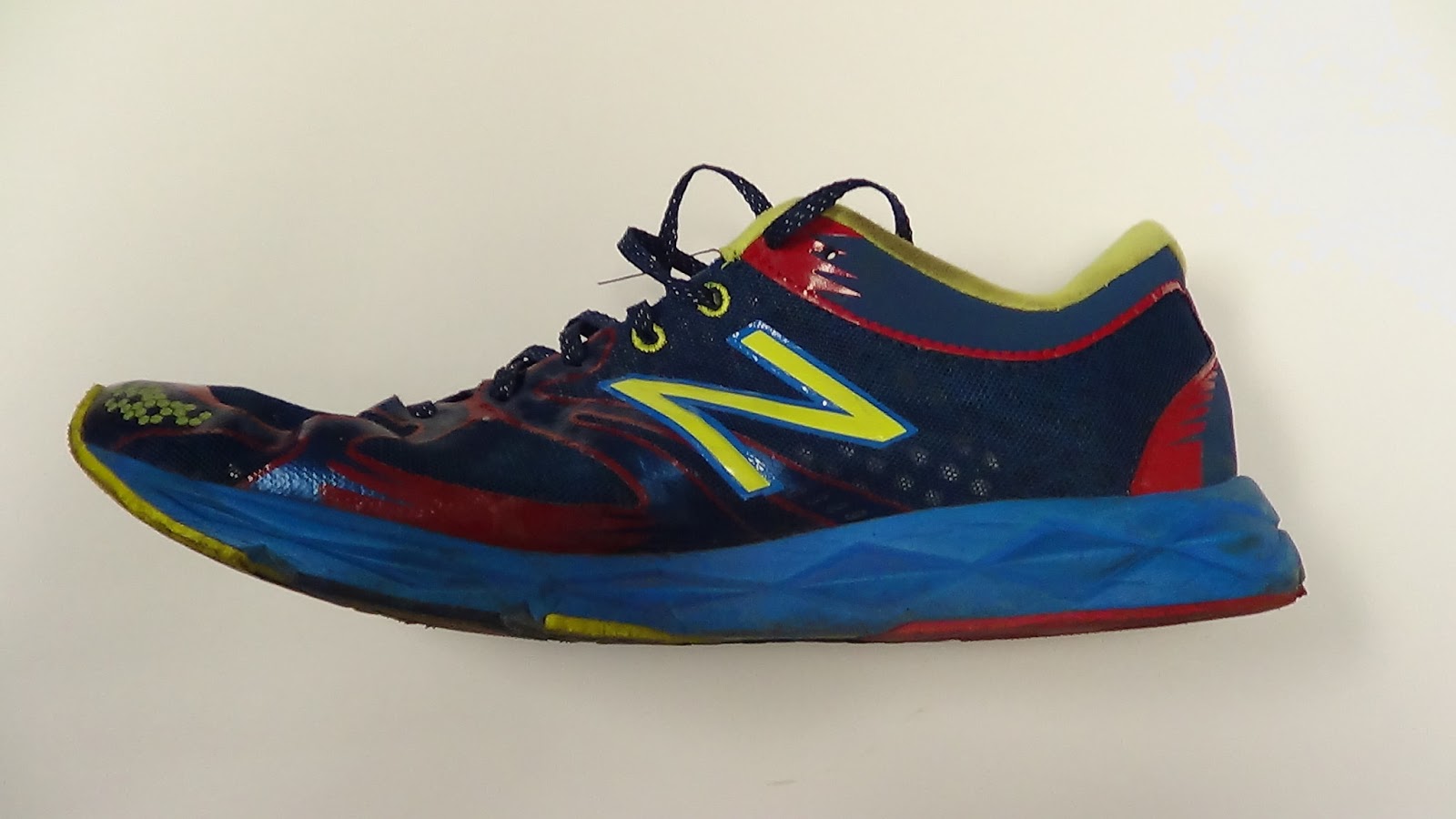
Shoe Review- New Balance 1400
What. A. Shoe. WEIGHT: 7.1 oz/5.7 oz
The New Balance 1400 is one of the best shoes I've ever run in. After having come from the Asics DS Trainer (which I loved until they changed it to add the heel-tongue thing they on the 16) and the Wave Elixir, then jumping the pond and into the New Balance 904s/ 905s then into the (oddly wide) NB 1190 after the discontinuation of the 905, I think my feet might have found their home.
The NB 1400 is labelled as a racing flat by New Balance themselves but it has so much more to offer. Sporting a more tradition 10mm heel drop it feels like your most reliable pair of runners, but it has a much lower profile than more traditional running shoes. This means that the 1400 is great for those who are looking for a more forward step. The lower profile in the heel means your heel won't be dragging quite as much when you step down, promoting a more forward foot strike and a faster push-off of the ground. Yet for those who are heel strikers, don't let the lower profile fool you. It may appear that having less bulky cushioning in through the heel is to its detriment but the 1400 still features NB's patented REVlite cushioning system meaning you'll have more than enough cushioning regardless of where your plant your foot.
The 1400 features no-sew welded seams creating a superb snug upper fit that is free of typical chaffing-causing seam protrusions. It offers a very supportive, comfortable upper fit that make the shoe feel as though it's just an extension of your sock.
The 1400 looks sharp and performs as such. It is ultra lightweight, super flexible and has that low to the ground profile you're looking for when you think of a fast shoe. It preforms well on roads, track and mild trails without any problems. It features a bit of a carbon plate through the arch for added support and strength while still allowing for natural foot movement and flexibility. The 1400 also features a sole all made of one material which lends to a very smooth and springy transition from heel through to toe.
I've been in this shoe for about a month; I've run 400-450 km in the 1400 and they have been great. I haven't run into any issues of wear and tear- no rips, nothing (although I did step in gum and it go lodged in the heel pretty good within my first week of having them). They've gotten me through some speed work on the track, some long tempo runs as well as all of my long runs.
There are a few thing to note however.
These are lightweight trainers. They are designed to be light and fast. They are not for people who are looking for the extra support or are in need of a plush and cushioned shoe. They are not going to last forever and for those who maybe want a shoe to last them for 6 months while still maintaining decent mileage (although no shoe can really do that) this is not the shoe for you. The shoe also fits slightly narrow through the heel-arch area. I have had no problems with it because I have a bit of a narrow foot for a guy but for someone with wider feet that could cause issues. It fits very similar to the Saucony Kinvara in terms of heel to arch fit, but it does have a wider midfoot to promote that performance midfoot strike.
Going to the other end of the spectrum, they aren't minimalist either. For those looking to "feel" the road and the ground below them, I wouldn't suggest the 1400. It still has the cushioning in the midfoot and heel so that you don't get enough of the ground to feel every orifice and rock that dots the terrain.
The 1400 isn't for everyone. If you have a wide foot you're out of luck- unlike a lot of other New Balance shoes it doesn't come in wide widths. If you're looking for a shoe that is overly plush or are looking go au natural and feel the ground, the 1400 won't do for you. But if you are looking for a light, flexible, fast shoe, the 1400 just might be right for you.
(Newer models also glow in the dark which is awesome).
Check out the New Balance 1400v2- Fully updated and ready to rock!
Men's
Women's
The New Balance 1400 is one of the best shoes I've ever run in. After having come from the Asics DS Trainer (which I loved until they changed it to add the heel-tongue thing they on the 16) and the Wave Elixir, then jumping the pond and into the New Balance 904s/ 905s then into the (oddly wide) NB 1190 after the discontinuation of the 905, I think my feet might have found their home.
The NB 1400 is labelled as a racing flat by New Balance themselves but it has so much more to offer. Sporting a more tradition 10mm heel drop it feels like your most reliable pair of runners, but it has a much lower profile than more traditional running shoes. This means that the 1400 is great for those who are looking for a more forward step. The lower profile in the heel means your heel won't be dragging quite as much when you step down, promoting a more forward foot strike and a faster push-off of the ground. Yet for those who are heel strikers, don't let the lower profile fool you. It may appear that having less bulky cushioning in through the heel is to its detriment but the 1400 still features NB's patented REVlite cushioning system meaning you'll have more than enough cushioning regardless of where your plant your foot.
| Runner's World Profile Chart |
The 1400 features no-sew welded seams creating a superb snug upper fit that is free of typical chaffing-causing seam protrusions. It offers a very supportive, comfortable upper fit that make the shoe feel as though it's just an extension of your sock.
The 1400 looks sharp and performs as such. It is ultra lightweight, super flexible and has that low to the ground profile you're looking for when you think of a fast shoe. It preforms well on roads, track and mild trails without any problems. It features a bit of a carbon plate through the arch for added support and strength while still allowing for natural foot movement and flexibility. The 1400 also features a sole all made of one material which lends to a very smooth and springy transition from heel through to toe.
I've been in this shoe for about a month; I've run 400-450 km in the 1400 and they have been great. I haven't run into any issues of wear and tear- no rips, nothing (although I did step in gum and it go lodged in the heel pretty good within my first week of having them). They've gotten me through some speed work on the track, some long tempo runs as well as all of my long runs.
There are a few thing to note however.
These are lightweight trainers. They are designed to be light and fast. They are not for people who are looking for the extra support or are in need of a plush and cushioned shoe. They are not going to last forever and for those who maybe want a shoe to last them for 6 months while still maintaining decent mileage (although no shoe can really do that) this is not the shoe for you. The shoe also fits slightly narrow through the heel-arch area. I have had no problems with it because I have a bit of a narrow foot for a guy but for someone with wider feet that could cause issues. It fits very similar to the Saucony Kinvara in terms of heel to arch fit, but it does have a wider midfoot to promote that performance midfoot strike.
Going to the other end of the spectrum, they aren't minimalist either. For those looking to "feel" the road and the ground below them, I wouldn't suggest the 1400. It still has the cushioning in the midfoot and heel so that you don't get enough of the ground to feel every orifice and rock that dots the terrain.
The 1400 isn't for everyone. If you have a wide foot you're out of luck- unlike a lot of other New Balance shoes it doesn't come in wide widths. If you're looking for a shoe that is overly plush or are looking go au natural and feel the ground, the 1400 won't do for you. But if you are looking for a light, flexible, fast shoe, the 1400 just might be right for you.
(Newer models also glow in the dark which is awesome).
![]() |
| NB 1400 HI VIZ |
Men's
Women's
Thursday, June 20, 2013
Man do your feet stink: On minimalism and barefoot
Is it finally safe to step outdoors again? Has the dust settled? After the meteoric rise of the barefoot and minimalist movement, it would seem as though the shoe genre is falling back to Earth. This, according to many industry analysts pointing to the 10% fall in minimalist shoes during the first quarter of 2013, could mark the beginning to the end of an era. That development is in contrast to SportsOneSource's quarterly reports
of the last few years, in which the minimalist category had some of the
highest growth, while sales in categories such as motion control and
stability stagnated or fell.
Sales in motion control shoes rose by more than 25% in the first three months of the year and hot on its heels was a 10% increase in stability shoes. In fact, barefoot and minimalist type running shoes only represented 4% of total running shoes in SportOneSource's analysis. Was barefoot really just a fad? Or was it just sorely misunderstood, a tortured sole looking for a home?
Much of the barefoot movement came about because of some pilot studies looking at various Kenyan tribes and one particular tribe in Mexico that runs long distances barefoot. It was reported that it was more fuel efficient- you spared your glycogen reserves more (your carbs), because your VO2 max was lower and you could use your high energy fat reserves longer- basically you were a running machine and super efficient. Your foot fall contact was light and your turnover quick- you were faster and you weren't stomping/slapping the ground when you ran. Maybe it was because you were more self-aware that you were running over hard surfaces, you could feel every stone and every crack, that you ended up changing your gait and your knee and hip alignment and you got less injured. These were all the reasons presented in these few pilot studies suggesting the benefits of switching to barefoot.
But new evidence is coming out that contradicts everything. Injury rates didn't fall, and in a lot of cases, they increased. New studies show that VO2 fell when going barefoot, and efficiency went down with it. Even the Kenyan foot strike data was disputed. And more science about the rearfoot strike being more economical at submax speeds has come out contradictory to the idea that barefoot is more efficient in terms of running.
After such a HUGE increase in the barefoot movement at the start of the decade, it seems to have come crashing down. But why? Most people who aren't in the know don't read all the scientific literature to see why it was or wasn't such a great idea. If I could hazard a guess as to why minimalism has slowed so much, it would be because of a lack of knowledge. People just jump head first into these things without ever knowing the how-to's and why's of the situation. People get injured and don't know why, when these shoes and the whole minimalist ideals are supposed to prevent injury.
The main thing that people don't realize is that barefoot running takes a long time to transition to. A long time. Especially if you've been running in big motion control and guidance shoes for so long. This is one of those things where you run maybe once or twice a week for 15 minutes at a time just to get used to it. You work your way up, GRADUALLY, to the point where you are able to run everyday barefoot or in your minimalist shoes, then you start ramping up your mileage in your minimalist shoes. Too often have I come across a poor soul that has destroyed their achilles or knees or shins from thinking they can do the same workouts they had previously been doing whilst in standard runners, but now in their trendy new barefoot shoes. And one of the problems was that dealers were all too happy to sell them to an unaware customer without warning them of the potential dangers of transitioning too fast to barefoot.
Which brings me to another point. Motion control shoes and stability shoes exist for a reason. People, if you haven't noticed, are different. We all have different running forms, our foot falls all differ slightly, and we each have our own, individualized gait. You could have the strongest feet in the world, but if you overpronate or you run knocked knee, guess what? Barefoot shoes aren't going to change that- it is just how you run, it is what is most natural for you. You do it naturally because it is what works best for you, it may not be efficient for others, but it gets the job done for you pretty well.
Maybe this decrease of the barefoot/minimalist is a good thing (much to the chagrin of podiatrists everywhere). Maybe it gives everyone a chance to step back and re-assess the realities presented. Some people swear by it and have found huge success with it. Others have scoffed at barefoot running and called it nothing more than a passing fad. There still remain many benefits of trying barefoot once and a while- it does indeed help to strengthen your feet and will get your foot speed turning over quicker, both of which are useful for being the best runner you can be. It has also drastically changed the running shoe market today. Heel-to-toe drops in running shoes are disappearing. Consumers are calling for shoes that are lower to the ground but offer more padding and cushioning than a traditional minimal barefoot shoe. Barefoot running will always have a niche I think, and minimalist shoes are great tools for becoming a better runner but the go-to shoes now are going to be lightweight trainers. Shoes which offer more neutral, cushioned shoes that offer a higher performance ride like the Saucony Kinvara and Virrata, the Brooks Pure Project, the "Zero Drop" style shoes like the Altra Instinct, and the New Balance 1400 and 890.
Until next time!
Sales in motion control shoes rose by more than 25% in the first three months of the year and hot on its heels was a 10% increase in stability shoes. In fact, barefoot and minimalist type running shoes only represented 4% of total running shoes in SportOneSource's analysis. Was barefoot really just a fad? Or was it just sorely misunderstood, a tortured sole looking for a home?
| My feet hurt just thinking of this. |
But new evidence is coming out that contradicts everything. Injury rates didn't fall, and in a lot of cases, they increased. New studies show that VO2 fell when going barefoot, and efficiency went down with it. Even the Kenyan foot strike data was disputed. And more science about the rearfoot strike being more economical at submax speeds has come out contradictory to the idea that barefoot is more efficient in terms of running.
After such a HUGE increase in the barefoot movement at the start of the decade, it seems to have come crashing down. But why? Most people who aren't in the know don't read all the scientific literature to see why it was or wasn't such a great idea. If I could hazard a guess as to why minimalism has slowed so much, it would be because of a lack of knowledge. People just jump head first into these things without ever knowing the how-to's and why's of the situation. People get injured and don't know why, when these shoes and the whole minimalist ideals are supposed to prevent injury.
The main thing that people don't realize is that barefoot running takes a long time to transition to. A long time. Especially if you've been running in big motion control and guidance shoes for so long. This is one of those things where you run maybe once or twice a week for 15 minutes at a time just to get used to it. You work your way up, GRADUALLY, to the point where you are able to run everyday barefoot or in your minimalist shoes, then you start ramping up your mileage in your minimalist shoes. Too often have I come across a poor soul that has destroyed their achilles or knees or shins from thinking they can do the same workouts they had previously been doing whilst in standard runners, but now in their trendy new barefoot shoes. And one of the problems was that dealers were all too happy to sell them to an unaware customer without warning them of the potential dangers of transitioning too fast to barefoot.
![]() |
| Vibram revolutionized the running scene and took the community by storm but people never knew how to get the most out of them. |
Maybe this decrease of the barefoot/minimalist is a good thing (much to the chagrin of podiatrists everywhere). Maybe it gives everyone a chance to step back and re-assess the realities presented. Some people swear by it and have found huge success with it. Others have scoffed at barefoot running and called it nothing more than a passing fad. There still remain many benefits of trying barefoot once and a while- it does indeed help to strengthen your feet and will get your foot speed turning over quicker, both of which are useful for being the best runner you can be. It has also drastically changed the running shoe market today. Heel-to-toe drops in running shoes are disappearing. Consumers are calling for shoes that are lower to the ground but offer more padding and cushioning than a traditional minimal barefoot shoe. Barefoot running will always have a niche I think, and minimalist shoes are great tools for becoming a better runner but the go-to shoes now are going to be lightweight trainers. Shoes which offer more neutral, cushioned shoes that offer a higher performance ride like the Saucony Kinvara and Virrata, the Brooks Pure Project, the "Zero Drop" style shoes like the Altra Instinct, and the New Balance 1400 and 890.
Until next time!
Friday, June 7, 2013
Running Shoes: Myths Debunked! PART 2
Myth #7: But I’m just a beginner. I don’t need all the fancy bells and whistles on the expensive shoes, do I?
BUSTED: I don't know about bells and whistles but it is imperative that beginners get the best shoes they can for themselves. Unfortunately, that's rarely the economic option. A beginner usually needs the best cushioning and support that he/she can find. It’s far more important for a beginner to spend a little more and get the best shoe, as opposed to someone who’s been running several years and already knows what works best. Their feet will have adapted and be that much stronger and be used to being used for strenuous amounts of time.
Myth #8: Cushioning is the most important factor for me. I’m a big runner and need as much cushioning as I can get. When I try a new pair on, I like that soft, cushy feel I get walking around in the store.
BUSTED: Almost all standard running shoes these days have adequate amounts of cushioning but some shoes/brands may have a softer level of cushioning or even a greater amount of cushioning. Yet that doesn't mean that a shoe has better quality or even a greater amount of cushioning. It simply means that it has a softer grade cushioning material (foam) which may feel amazing when you're simply walking around in the store. But just a light walk from one end to the store to another is not an adequate way to truly test a shoe's cushioning level. Researchers have long ago concluded that a running shoe with softer cushioning (rather than firmer) increases impact forces. There’s no evidence that a softer cushioned shoe is better for you than a shoe with greater firmness. In addition, running shoes that are too soft bottom out on road surface, don’t support the foot well (the foot sinks into the midsole) and the cushioning wears out quicker.
Myth # 9: It takes me two or three weeks to break in a new pair of shoes. It’s frustrating that it takes so long.
BUSTED: It's quite understandable that you'd be frustrated. But the reality is that today's running shoes are good to go right out of the box. The idea that you had to break in a pair of runners is something of a by-gone era (the 70s and 80s) when many running shoes had a board in the rearfoot, ere very stiff and necessitated several short break-in runs. It’s simply not necessary today. The only exception is before an important race (especially a marathon) a few shakedown runs are important.
Myth #10: I’m a woman who is tired of buying women’s shoes. It bothers me that women’s running shoes are technically inferior to men’s and just more colorful versions designed to pander to women.
BUSTED: That simply is not true. It used to be true when women made up a fraction of the running population and women’s running shoes were a little narrower, but today’s women (who make up more than half of all runners) demand just as good a shoe as men. Women are more sensitive to fit than men and absolutely won’t settle for a running shoe that doesn’t fit properly. Many shoe brands design their ladies shoes with lady-specific lasts, and softer/lighter material for the upper meshing of the shoe.
Myth #11: I like to rotate between two pair of the same model shoe. That way I can extend the life of the shoe.
BUSTED: There’s certainly nothing wrong with using two different pair of training shoes, but it won’t extend the life of a shoe. Shoes have a limited life span of a certain number of miles (which differs for everyone) and rotating between two pairs won’t help the shoes last longer. Shoes don’t need a day or two of rest like you and I do. Generally, a running shoe’s midsole (the cushioning element) needs just a couple of hours of “rest” to rebound from the day’s run, rather than 24 or 48 hours to recover. Doing so, won’t hurt the shoe but it won’t extend its durability.
Myth #12: Minimalist running shoes are the best way to improve running form.
BUSTED: There isn’t anything magical about minimalist or zero drop shoes. Yes, minimal running shoes—i.e., shoes with minimal cushioning and lowered (or zero) heel heights—might help you change your stride, but it is usually more of a result of making a conscious decision to change your running form and foot strike while running in this type of shoe. While it is true that because of the low heel heights and overall lightness of minimal shoes, runners do tend to strike the ground lighter and closer to the midfoot or forefoot with each stride. But, there is still an adaptation period as the typical runner has to biomechanically retrain. The shoe won’t do that; the runner must. Even so, many runners in minimalist shoes, continue to heel strike, just as some runners in conventional training shoes, use a mid or forefoot strike.
So there you have it, myths debunked. If you have questions that you want to ask please do so in the comments or if you want to chat further shoot me an e-mail! I'd love to hear from you.
And as always, check out Runner's Mark
Running shoes: Myths Debunked! PART 1
Buying running shoes should be the simplest task in running. But the fact of the matter is that it is one of the most challenging aspects of running for most runners. There are so many options and with so many terms like "gait analysis," "barefoot minimalism," "structured support," and "ultra-lightweight" being thrown around theses days, finding the right shoes for you can be a bit of an adventure.
Also getting in the way of selecting the right shoe for you are an exorbitant number of myths surrounding running shoes. Many of these myths may have had basis 20-30 years ago, but today they are just that- myths- not grounded in reality, which somehow have managed to endure.
The separation of fact from fiction is an always challenging battle due to the grounded and ingrained misinformation that has based itself within the running community. Such things do nothing but complicate the matter of selecting new running shoes.
Here are but a few of the most common myths surrounding running shoes:
Myth #1: There is a best shoe for every runner.
BUSTED: There simply isn't. Perhaps you've found a specific shoe model that you deem to be the best or you've found a brand that you can reliably turn to when looking for your next pair if your model has mysteriously been discontinued or the update wasn't quite what you were looking for. But there is simply no one running shoe that is the "best" shoe. Running shoes do not deal in absolutes, there is no one shoe or brand that is the be-all and end-all of running shoes that works for every runner. And the reason why there isn't an absolute best is because we are all different. We all have individual biomechanics which dictate how our bodies move, how our feet fall and ultimately, what type of shoe will work for us. The greatest running shoe on the planet won’t work for everyone and the worst running shoe will work for some runners. Don’t worry about what someone else says or recommends; get the best shoe for you. Spend the time to try the shoes on, make sure its the right one for you.
Myth #2: All running shoes are basically the same
BUSTED: Not true at all. It is a known fact that each company has their own patented special shoe technology, be it their type of cushioning or gel supports or some type of carbon-fiber speed plate, but further than that, each shoe simply fits differently. Each shoe company has their own unique foot mold that they deem is the right one and that is the one they are going to use. Different shoe are going to fit differently. What one brand may deem to be a size 8 may in fact be more like a size 8.5 in another brand or a 7.5 in an other. That’s why a shoe or a specific brand your running partner swears by might not work for you because it may not fit you as well as your friend. Fit is absolutely the most critical factor when selecting your next pair of running shoes. The fit characteristics every runner should seek in every pair of shoes is a snug heel without any slippage, enough space for the ball of the foot and wiggle room for the toes. Comfort and fit are the two greatest factors in reducing risk of injury. Never compromise on fit.
Myth #3: The shoes make the runner
BUSTED: This one may seem a little self-evident but the fact is, some people still think that by simply having the most expensive or flashy-looking shoes, they will instantly be a better runner. The key great running isn't shoes. Shoes are necessary tools but they are not what makes you the runner. The training, the dedication, the commitment and the sheer will to be better are what make you a better runner. Shoes can help you along the way by adding protection and stability for those who need it, but the key to great running is staying health and being consistent. In other words, great running is being able to run everyday. Shoes certainly help, and are usually required, but they do not make you a better runner.
Myth #4: I’ve heard the wet test (i.e., placing a wet foot on a dry surface) is the best way to determine my foot type and the type of shoe I should wear.
BUSTED: You heard wrong. A simple tracing of your foot and/or the wet test is not an accurate predictor of your foot function. Only severe overpronators (with a full, flat arch) or extreme underpronators (with a high arch) have definitive foot shapes. For anyone else, the wet test is pretty useless. There have been no studies or scientific literature that have ever suggested that foot shape accurately indicates what kind of shoe is the best for you. In fact, three recent studies conducted by the military showed consecutively that wet test/foot shape test and assigning shoe type based on that had the slightest impact of injury rates.
Myth #5: My shoes wear out first on the outside of the outsole which I know means I’m a supinator, right?
BUSTED: If you are a TRUE supinator, the actual supination movement happens well after you land. Wear on the outside of the heel is the most common wear pattern within the running population because 75-80%. The simplest explanation for this is because most runners land with their heel and strike with their outside of their heel first. Which is precisely the point where most of the wear pattern occurs. But that is all it means.
Myth #6: I know I need to buy a good shoe, but a $50 shoe is just as good as shoes costing $100 or more.
BUSTED: Not in a million years. Different models have different materials and technologies, and they are going to fit differently. Running shoes are very different from each other because of each brand's individual foot mold, the technology they have at their disposal, and their own personal design choices. Buying a $50 department store athletic shoe may seem like an economic choice, but realistically you bought something that is going to wear out faster and it isn't made for running. You have different shoes for different sports because they are the proper tools to help you be the better athlete (in our case, the better runner). Even if the shoe is supposed to be purposed as a running shoe, the sweet spot in running shoes (between $125-$160) offer the best shoes in terms of cushioning, support, fit and durability.
If you have questions that you want to ask please do so in the comments or if you want to chat further shoot me an e-mail! I'd love to hear from you.
And as always, check out Runner's Mark
Also getting in the way of selecting the right shoe for you are an exorbitant number of myths surrounding running shoes. Many of these myths may have had basis 20-30 years ago, but today they are just that- myths- not grounded in reality, which somehow have managed to endure.
The separation of fact from fiction is an always challenging battle due to the grounded and ingrained misinformation that has based itself within the running community. Such things do nothing but complicate the matter of selecting new running shoes.
Here are but a few of the most common myths surrounding running shoes:
Myth #1: There is a best shoe for every runner.
BUSTED: There simply isn't. Perhaps you've found a specific shoe model that you deem to be the best or you've found a brand that you can reliably turn to when looking for your next pair if your model has mysteriously been discontinued or the update wasn't quite what you were looking for. But there is simply no one running shoe that is the "best" shoe. Running shoes do not deal in absolutes, there is no one shoe or brand that is the be-all and end-all of running shoes that works for every runner. And the reason why there isn't an absolute best is because we are all different. We all have individual biomechanics which dictate how our bodies move, how our feet fall and ultimately, what type of shoe will work for us. The greatest running shoe on the planet won’t work for everyone and the worst running shoe will work for some runners. Don’t worry about what someone else says or recommends; get the best shoe for you. Spend the time to try the shoes on, make sure its the right one for you.
| Don't worry, we've got you covered |
BUSTED: Not true at all. It is a known fact that each company has their own patented special shoe technology, be it their type of cushioning or gel supports or some type of carbon-fiber speed plate, but further than that, each shoe simply fits differently. Each shoe company has their own unique foot mold that they deem is the right one and that is the one they are going to use. Different shoe are going to fit differently. What one brand may deem to be a size 8 may in fact be more like a size 8.5 in another brand or a 7.5 in an other. That’s why a shoe or a specific brand your running partner swears by might not work for you because it may not fit you as well as your friend. Fit is absolutely the most critical factor when selecting your next pair of running shoes. The fit characteristics every runner should seek in every pair of shoes is a snug heel without any slippage, enough space for the ball of the foot and wiggle room for the toes. Comfort and fit are the two greatest factors in reducing risk of injury. Never compromise on fit.
Myth #3: The shoes make the runner
BUSTED: This one may seem a little self-evident but the fact is, some people still think that by simply having the most expensive or flashy-looking shoes, they will instantly be a better runner. The key great running isn't shoes. Shoes are necessary tools but they are not what makes you the runner. The training, the dedication, the commitment and the sheer will to be better are what make you a better runner. Shoes can help you along the way by adding protection and stability for those who need it, but the key to great running is staying health and being consistent. In other words, great running is being able to run everyday. Shoes certainly help, and are usually required, but they do not make you a better runner.
Myth #4: I’ve heard the wet test (i.e., placing a wet foot on a dry surface) is the best way to determine my foot type and the type of shoe I should wear.
BUSTED: You heard wrong. A simple tracing of your foot and/or the wet test is not an accurate predictor of your foot function. Only severe overpronators (with a full, flat arch) or extreme underpronators (with a high arch) have definitive foot shapes. For anyone else, the wet test is pretty useless. There have been no studies or scientific literature that have ever suggested that foot shape accurately indicates what kind of shoe is the best for you. In fact, three recent studies conducted by the military showed consecutively that wet test/foot shape test and assigning shoe type based on that had the slightest impact of injury rates.
Myth #5: My shoes wear out first on the outside of the outsole which I know means I’m a supinator, right?
BUSTED: If you are a TRUE supinator, the actual supination movement happens well after you land. Wear on the outside of the heel is the most common wear pattern within the running population because 75-80%. The simplest explanation for this is because most runners land with their heel and strike with their outside of their heel first. Which is precisely the point where most of the wear pattern occurs. But that is all it means.
Myth #6: I know I need to buy a good shoe, but a $50 shoe is just as good as shoes costing $100 or more.
BUSTED: Not in a million years. Different models have different materials and technologies, and they are going to fit differently. Running shoes are very different from each other because of each brand's individual foot mold, the technology they have at their disposal, and their own personal design choices. Buying a $50 department store athletic shoe may seem like an economic choice, but realistically you bought something that is going to wear out faster and it isn't made for running. You have different shoes for different sports because they are the proper tools to help you be the better athlete (in our case, the better runner). Even if the shoe is supposed to be purposed as a running shoe, the sweet spot in running shoes (between $125-$160) offer the best shoes in terms of cushioning, support, fit and durability.
If you have questions that you want to ask please do so in the comments or if you want to chat further shoot me an e-mail! I'd love to hear from you.
And as always, check out Runner's Mark
Subscribe to:
Posts (Atom)