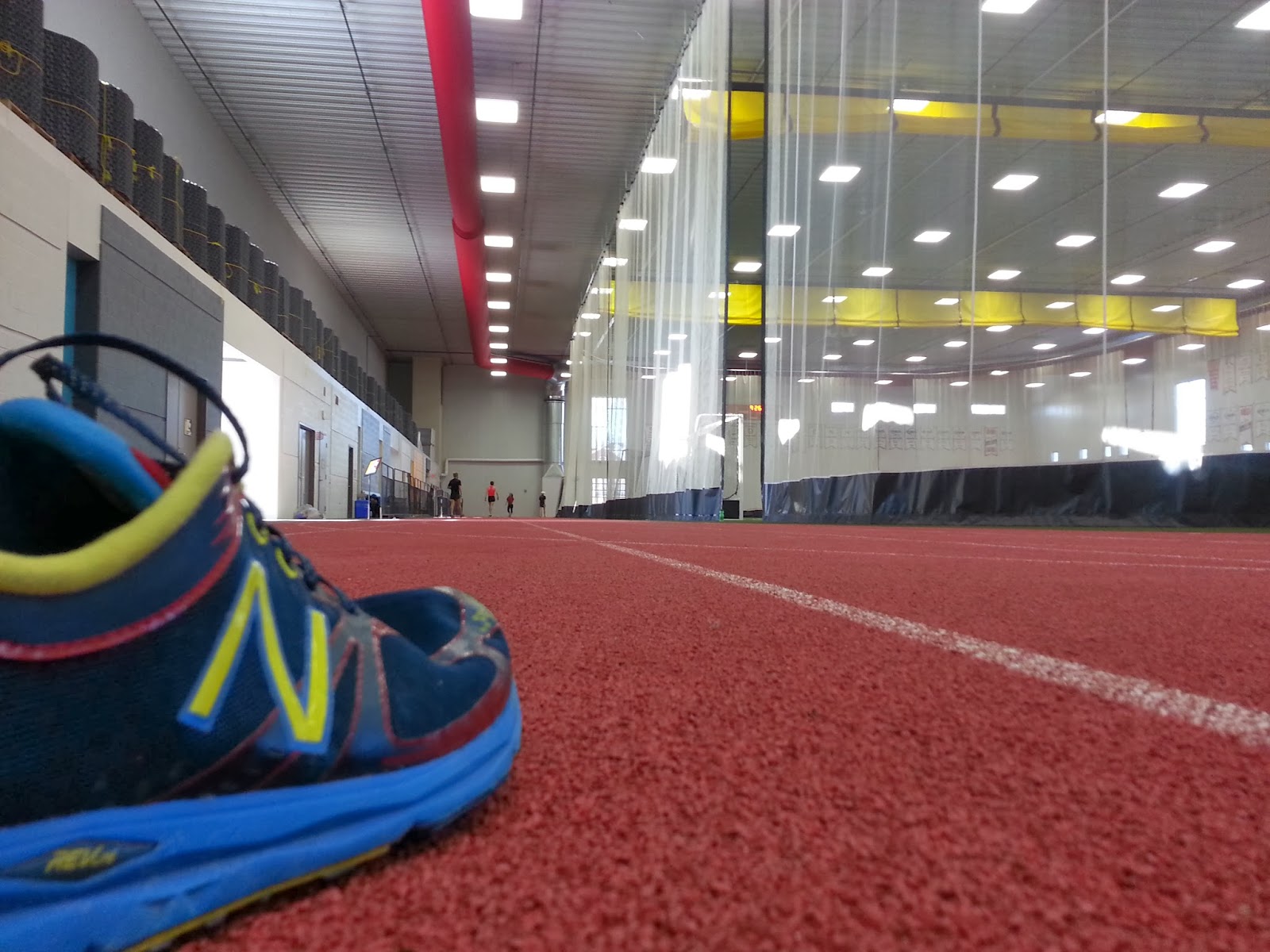
Recovering for the indoor track, had a little tumble on the snowy, icy trails this morning. Folks, falling hurts. Falling in front of people hurts more. Don't fall in front of people. They will laugh. They won't ask you if you are alright, they will just flat out laugh in your face. What dinks.
The marsh is nice at dusk...
I worked in the store the rest of the day. It was pretty boring. None of you fine runner's came by to say hello! Jeeze. I started to re-merchandise the store as well. I should be done tomorrow! We have some really cool stuff in... there goes the next paycheck... ouch.
Went to the gym after work to do some miles on the treadmill. It was still slippery from the previous day's snow fall. I didn't want to fall in the dark. Coyotes may be waiting in the wing, ready to pounce! Yikes!
An hour and a half and 12 miles later, we are done for the day!
Old man winter is one grumpy SOB. I get up, it it still mild, do an easy 5 miler, then as I am going to school, it really starts to come down. REALLY STARTS. No way I am running outside again today. I was relegated to the indoor track YET AGAIN! Luckily I was able to meet up with my good buddy James and we ended up doing a 70 minute long run on the outside lane of that indoor beast.
I am getting REAL tired of your shit winter. I am so ready to have a solid week out outdoor mud runs. No tights, not hats- just shorts and some trail shoes.
Sorry I've been MIA the last couple of days. I was busy with running (duh) but also, I've had some work to do for the store and with school. As well as trying to be a good guy and spend some time with the lady friend.
Thursday (Day 6): Got to the store early to do a quick run before I opened the shop. Sitting in the store all day with no one coming in is one of the most boring things to do in the world. That's a solid 10 hours in one place. I am a very antsy person. I need to be doing things, multiple things, all at the same time. I can't sit still for very long and my mind starts to wander. So nothing much fun to report.
In the evening I headed out to the treadmill just to have some bodies around me. running alone in the dark and cold is starting to get REALLY lame. Ended up with a solid 19 miles on that electronic beast and had a great day for mileage.
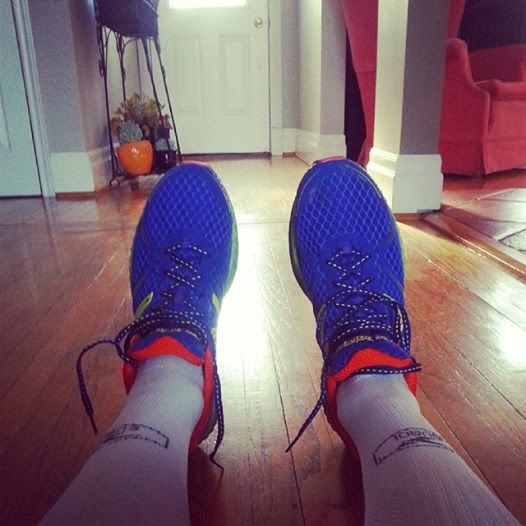
Recovery has become a must- fashion police be damned. Compression socks to increase blood flow and my New Balance 980 Fresh Foam for the best feeling, plush shoes on your feet.
TODAY: 24 miles
Friday: I don't want to talk about Friday. I rolled out of bed and was able to shuffle through a lame 10 miles. Can you believe when I asked my dog if she wanted to go with me she just looked at me as if I were an idiot? 10 miles turned out to be it for the day. And that sucked because the rest of Friday just got glorious. It got up to 6 degrees (or so I was told) but because again, I was in the store by myself for 10 hours, I didn't get to experience the first taste of spring! I got pretty depressed and didn't run at night. I just couldn't mentally do it- I was so defeated after seeing the sun out all day and then when I end up leaving it's dark again and the temperature has dropped. Not Cool.
Crushing the remnants of winter in my New Balance MT110 trail shoes. Feeling great.
TODAY: 10 miles
Saturday: Saturday, the Runner's Mark First Half Marathon crew headed down tot he Hammer to run the back 9km of the Around the Bay (ATB) course (Out 9km, back 9km). It was us and about a million other runners out there. Carl told me that this was the big weekend for people to go to the course as it is 2weeks out from ATB but I still have never seen so many runners out for something that wasn't an organized event or anything. It was great to see and most people looked like they were having a great time. Smiles all around (for the most part- once the hills started to kick in there was a lot of cursing going on). It was a pretty slow run; it was the furthest that the majority of the group had ever run before so there might have been a little trepidation. But hey, they got it done and they're doing great!
After the run I took my mom to go see Mr. Peabody and Sherman. It was a cartoon that she enjoyed as a child and this update was quite enjoyable. There was lots of spectacle for the little kids but the dialogue and the jokes were really geared towards the older crowd. There were even some pretty great pop culture references that only denizens of the internet like myself would fully appreciate.
When we got out of the movie theater it was actually SUNNY! So of course I was going to go for a run to enjoy it! Belly full of popcorn or not, I was going to get a glorious 8km run in the sun.
A glorious afternoon run down through Rattray Marsh and a long Lake Ontario.
Well that's five days down. Now only... too many days left. I'm at the point where if I start to think about it, the more daunting it seems. Either way, a lot of days still to go.
But the good news is that I'm still feeling pretty good. yesterday I was pretty sore after slipping around in the snow on Tuesday night but I came back pretty well with a decent 18 minute 5k tempo on the track. I finished my last kilometer in 2:55 and felt great so I know I'm not losing a whole lot with mileage.
I was supposed to help a friend through the 5k but James was a goof and did a workout the day before. He was trying to tell me it was just some fun 200s but I wasn't buying it. But he still got the effort in which is important. he will be racing the Marden Half Marathon early April so he's been training pretty hard and getting ready for it. I expect him to do awesome so he better not let me down (pressure's on dude).
The name Marden brings up rather ghoulish memories from my days as a varsity athlete at the University of Guelph. You see, Guelph never had a real indoor facility until last year. In my first year we had a dome structure that was made by the same company that provided the Dallas Cowboys' training dome- you know, the one that toppled over and injured all those people a few years ago? Anyway, Guelph had one of those with a 175m indoor rubberized squared-off track.
I almost miss this place... almost.
It wasn't the greatest to run in because of the square corners-a line was painted on that cut the corner into a smoother radius, but you were still flung way out with a slingshot effect coming out of it. Then with the Dallas Cowboys facility collapsing, safety concerns made Guelph tear out little dome down- the varsity track and field team was now without a home! Luckily for us, a new facility up in Marden was just being finished, complete with a 220m indoor track (although still squared off, the long straights were fun for indoors).
So every time we wanted to go to the track we would have to hop n a school bus and be bused up there for our track workouts. While not the worst, it ate a significant amount of time out of our day. Plus the corners. Oh god the corners. They were still so tight. I'm a wimpy runner. When things don't go my way I break pretty easily (or used to- i am getting a lot better). Plus I am a pretty springy runner from having tight joints. having a springy step and tight corners isn't fun. You feel like you are going to fly apart in different directions, blasted to oblivion and sprawled out on the track, limbs all over the place. It wasn't fun. I no like. Such distress. Much defeat. Sadface.
If you look real close you can almost see the dotted line that you follow to do a "corner." If you look harder you can see my tears and my broken spirit.
Kids these days don't even know how good that have it at Guelph. the indoor track they have now actually has REAL CORNERS! No rounded squares, REAL LIVE CORNERS! The track surface may be slow as maple syrup but there are corners and that's all that I care about.
That is my aside for the day. Long winded and maybe a little dull but it's my life okay? No need to make snide comments about it.
The evening run went well. Even though it wasn't super cold, I am still so done with this winter it isn't even funny anymore. Seriously, if I'm not in shorts by March 20th I am going to flip my you know what and go live in a hole for the rest of my days.
Here's a picture of my bird checking out my New Balance Fresh Foam 980s to keep you coming back.
The morning went well. I woke up early and ran with the pooch. Normally she goes out with my dad, but my dad went down to Whiteface to ski with a friend for a few days so I was on dog duty. She isn't exactly the best running buddy. She likes to stop and sniff a lot. Like every three meters. Then she sprints ahead and stops to sniff until I pass her then she sprints ahead again. She would do this for a while but I don't think she liked that fact that I wasn't going as slow as my dad. He tends to do a half-waddle/shuffle when he runs so I think the pooch thought that she could handle the run. But I could tell she was getting tired because she stopped sprinting ahead and just started to trot beside me looking rather dejected.
This is Peaches. She is wondering why I made her run with me. I told her I liked her company. She wasn't buying it.
We ran just over 7 miles together. She wouldn't look at me when I came home last night though. I think she was still miffed that she couldn't stop to smell all the beautiful yellow snow around the street corners.
Yesterday was also a great day because my New Balance shipment of shoes arrived! I had ordered a pair of RC1600s and 2 pairs of their new 980 fresh foam. I just have to tell you, the 980 fresh foam may turn out to be my favourite shoe ever. Sure, it isn't as responsive as say the 890 or the 1400, but they are light, super cushioned, and the upper is one par with the comfort level I get when wearing my Altra Instinct 1.5 around the store. And with a 4mm drop I don't get any of the odd jolts from a high stack height that I now get. I got two pairs because I was thinking I would wear one as a trainer and I would use another pair as a recovery shoe because of how soft and cushioned they are.
I decided to run in them last night but to my astonishment, it was snowing yet again! I thought screw it and let's get it over with. Tuesday nights are usually our clinic nights out of the store but only 3 of our runners showed up! I don't blame them; the snow was the type that just kind of really fine powder that just compresses and doesn't melt when cars go over it. It creates a layer of the slickest running surface you don't ever want to run on. And because it was clinic night, I usually try to run with the attendees but with the snow being so slippery and having to brace with every step to slow myself, I found it extremely hard on my groin and hip flexors. I ended up doing about 5 miles there, then just took off and finished another 4 miles at home.
What I am trying to get at is that I will be taking applications for people who want to massage my butt and quads. (PLEASE??? I'll be your friend!)
Sorry folks, this update's a day late. I was dead last night. Like not even wanting to talk to my girlfriend dead (and I'm not one of those guys who does that to people I love). I had my head on my chest by 9, nodding off in front of my TV (I haven't gone to bed at 9 since I was about 7 years old).
The morning started off like any other this winter- cold and dumb. I have had with this (expletive) this (expletive) winter! (Picture me doing my worst Samuel Jackson impersonation a la Snacks on a Plane). It was -17 degrees out there plus some wind! NO WAY!
So I took my run to the indoor 200m track on the University of Guelph Campus.
Down the home stretch in my NB 1400
86 laps. 86 LAPS ON THAT TINY MONSTROSITY! My poor hips. My poor calves. I can't believe I put myself through that torture. I'm not the most mentally strong runner- I get discouraged easily but that's part of what this challenge is about- getting stronger both body and mind.
The run was made a little easier when some of the Speed River Marathoner's stepped on the track to start their workout. One of the many advantages of running in Guelph is that you can randomly bump into an Olympic Marathoner just going out for his daily workout. Eric Gillis and his Speed River compadres Nick Sunseri and John Mason were doing some 1ks... they were going fast and it made me feel sad that I am so slow.
Canadian Olympic Marathoner Eric Gillis doing work on the track.
Nick and John rolling on the track
The afternoon/ evening run: hey, guess what? IT WAS COLD AGAIN AT NIGHT! Whoever pissed off the winter gods or whatever, I hope you stub your toe REALLY hard! But got an additional 6 miles in and that's just more money in the bank.
Booyah
(how I feel when I finish another day of the challenge)
Miles today: 17
Miles in the bank: 50.5/500
***CameronHelps Needs Your Vote***
Runner's Mark is very involved with a youth program called CameronHelps, a program designed to teach physical activity and a sense of belonging as part of a way of coping with stress and depression. Having dealt with both of these problems in my life, this is very important to me and something that I hold close to my heart. CameronHelps now has the opportunity to win $50,000 grant from MLSE if selected as one of the top 4 causes by popular vote. It would be great if you can go to the MLSE Team Up Fund page and vote for CameronHelps as your favourite charity; that would be spectacular. It will help to further develop youth programs and will immediately have an impact on the hundred of youths already int he program.
Different is Good
I had never seen an Altra shoe prior to walking into the store. They have an oddly wide toe box and were designed to be fully "zero drop" meaning the heel to toe offset was just that: zero. Having been so used to the industry standard of shoes coming to a narrow, pointed toe, the Altra presented itself as an odd creature. At first I flat out didn't like it. It was too odd looking with the wide toe box in stark contrast to what the industry standard is. I've run in zero drop, minimal shoes before (the minimus zeros) and was fine with that, but aesthetic was just... no. But like any intrepid young runner, my curiosity got the best of me. I just had to see what they were all about. And I'm glad I did.
Although I initially looked at my feet in these odd-looking shoes with more than a little trepidation, I now see them as possibly the most comfortable shoes I've ever worn. The wide toe box may turn off some at first glace but I implore you to try it. It allows your toes to fully splay in a more natural movement, which I find helps even with basic blisters and preventing blackened toe nails. It should be noted that I am not a barefoot running enthusiast. I don't have any burning desires of getting connected with the ground or having the oft delusional view that running barefoot is the key to being injury free. BUT I do know that running barefoot and training with minimal shoes is a great tool to build minute muscle strength in the foot and ankle and correct poor running form/posture. Having your toes splay helps greatly with balance and posture by distributing your weight throughout your foot and especially your big toe (where most of your foot balance comes from). I can't tell you enough how much I like the wide toe box. It is just so roomy and comfortable while walking or running that I'm surprised I put up with other things for so long. And not only that but the shoe's aesthetics have grown on me as well. Once they are on your feet they actually look pretty good. I don't know if it is because it looks closer to your own foot shape and there is some primordial, ingrained perception that our feet are supposed to look a certain way and we subconsciously love it when we can see our own foot shape (have to throw some stuff in for those of us who are more inclined to conspiracy theories). Even my mother, who saw them just as I did at first, weird looking and different, now wants a pair after seeing them on my feet. I talked a lot about the aesthetic because from what I've heard from
people in the store is that they just don't like the look; It's too
different. Well, different is actually good.
Performance: The Samson (men's) and the Delilah (women's) are Altra's barefoot style shoe. Having a mere 3.4mm thick midsole and 3.5mm outsole, the Samson is pretty bare-bones. Those who are looking for something to put on their feet with more padding should consider something else. Those who are looking to really feel the road and every little rock should also look somewhere else however. While the Samson is super light and amazingly flexible (you can roll it up and stuff it in your pocket if you really wanted to), the sole is very dense and very high quality EVA. I've run several back-county cottage roads filled with rocks, as well as done some trail running in them and haven't so much as flinched when stepping on rocks. I wouldn't advise running on hard surfaces with them, especially right at first and if you aren't used to running in a barefoot style shoe as these WILL force you to change your running style.
Now I've taken to wearing them for every day use. They are super lightweight, super flexible and above all, superbly comfortable. I have found that they may need a little bit of something in the arch for those who either haven't run barefoot before (or if you're like me, haven't run in minimal shoes for a few months). The easiest solution I found was to just shove my old barefoot science in them and that solved the problem almost immediately.
These shoes aren't going to be for everyone (although I encourage everyone to give them a try). They are very minimal and as such require a bit of a "learning curve" to adjust to the minimalist running style. They are don't offer a whole lot of cushioning (heel strikers beware), but do offer quite a bit of protection thanks to the dense EVA rubber. I still find it a little difficult to run on pavement in these but through trails and softer surfaces these work great (although I would watch out for really wet days as there are no lugs what so ever on these puppies and you'll be sliding all over). There really isn't any support in these. Those who need some stability/guidance should look elsewhere. The curious looking toe box is at first startling and may be a turn-off. But that's actually one of it's bets selling features.It allows for free toe movement and for people who need a wider toe box, this is perfect. Even if you have a more straight, narrow foot (me), these still fit like a glove. They also make great cross-training/ gym shoe thanks to their flexibility and wide toe box which helps when gripping and balancing for lifting and plyometric movements. FITTING TIP: I suggest trying out a half a size down from your normal size (ie- if you're a 9, try an 8.5) for men. However, the women's fit small and I'd suggest going up at least half a size or more.
For those who are looking for a fast, neutral shoe but need more cushioning, also check out the Altra Instinct.
Do you live in the GTA? If you do, I feel sorry for you (I feel sorry for myself too, but I can deal with it). It's hot out. Grossly hot. Stupid hot (why weather why?). Mainly due to the humidity but regardless, it doesn't make for the greatest running weather. So what do you do when it's blisteringly hot out and you have to get your workout in? Well, the key, as always, is to stay hydrated. The human body is comprised upwards of 60- 70% water in grown adults, more so in young people. And humans sweat to stay cool; although there is great variability between individuals, humans can lose up to 2 liters of sweat per hour of very intense exercise, or one liter during moderate exercise. This only worsens during hot weather and can be compounded by the fact that sweat can evaporate so fast that people think that they aren't actually sweating. Then they keel over due to dehydration and heat exhaustion.
So hydrating yourself while you workout is a must. But what a lot of people fail to realize is that sweat has a lot more to it than just water. You can drink all the water you want but if you don't hydrate properly, your performance is still going to suffer. Through the course of your workout you'll lose not just water, but you'll have expended your sugar reserves (glycogen), as well, a lot of your "salts" (electrolytes) will have been lost through sweat. Someone was smart enough to realize that if you added sugar and salt to water, you could get a boost in performance- thus Gatorade was formed. This Florida-based sports drink is heavily credited as being the first major sports drink on the market (in North America at any rate). It would soon lead to the revolution of sports drinks we have today- different sweeteners being used, different electrolyte profiles, protein content, calories, etc, etc.
Why are there so many of them though? There must be a single, best drink out on the market, shouldn't there? Well, no, not really. With there being so much variability between individuals there can't be just one that works for everyone. One of the main reasons is because of the science of the sugars that each sports drink uses. If you've ever chugged a Gatorade then tried to go for a run, I'm sure you felt it- the feeling of being bloated, sluggish, or suddenly getting cramps when you KNOW keeping hydrated prevents cramps (that's part of it but not the whole story-more on that another time). That feeling of being bloated is because of the sugar content. Sugars delay gastric emptying and cause those gassy, bloated feeling stomachs. One of the main culprits is high fructose modified corn syrup. The same sweetener that is in everything you eat these days is by far the worst form of sugar for you. It causes you to be extra gassy and instead of being converted into glycogen like most sugar molecules, it is preferentially converted into fat.
Fructose and Glycogen Pathway- SCIENCE!
That is why so many other sports drinks exist. They use alternate sweeteners that are "easier" to digest and more efficient at giving you energy (glycogen is your main source of energy for any activity over 65% VO2max). That is why you'll see things like maltodextrin, sucrose, brown rice sugar, etc, most of which are usually just glucose polymers or different glucose molecules. Some are easier to digest than others, but again it relies heavily on the individual's ability to break down certain molecules and use them as an energy source. Where a lot of sports drinks fail is when it comes to their electrolyte profile. Most sports drinks seem to get at least two things right: Potassium and Sodium- these two ions are crucial for electrical stimulus and nerve firing in your body and they are easily lost through sweat. However, there are two crucial ones that Gatorade and Powerade neglect- Magnesium which is crucial for muscle and nerve function (producing energy), and Calcium which has its most important role intracellularly causing muscles to contract (if you can find one with chloride in there the better- you need chlorine to balance out your nerves and muscles during impulse firing). Having a good profile of all four (or five) of these electrolytes is hugely important to overall health and to maintain peak performance during strenuous exercise.
In short, the best sports drink is one that is going to sit well in your stomach (so as not to make you feel bloated and crampy), provides a suitable carbohydrate profile to keep you glycogen reserves up, and has an adequate profile of the four/five main electrolytes. Somewhere in vicinity of 100mg Sodium, 50-60mg Potassium & Calcium and 100mg Magnesium would constitute the electrolyte profile of a very well-rounded sports drink. The one that I would recommend trying is HoneyMaxx.
HoneyMaxx is unique in that it is the only sports drink on the market that uses honey as its base sweetener (mixed with maltodextrin). Honey is sweetened by a multitude of sugars including glucose, fructose, maltose and sucrose. You might be thinking, "Hey! You said sugars were gassy and bad and fructose was the worst of all! What gives?" And you'd be right. But remember, this is all-natural fructose- untampered by modification processes. So even though it gets converted to fat faster than any other sugar, it doesn't come with any of the chemical baggage associated with the corn processing. And the make-up of honey is such that it isn't so dependent on any one carbohydrate source for its sweetness. Rather, it has a wider profile of sugars in lesser individual quantities which means it sits a lot nicer in your stomach. The sugar profile allows things to be broken down more easily and efficiently which causes less strain to the gut which means less cramps and gastrointestinal problems for you on your run. For those diabetics looking to get into shape or if you are worried about drinks that raise your blood sugars too much- especailly for children growing up these days, HoneyMaxx is a great alternative. HoneyMaxx's sugar profile alters gastric emptying and helps decrease the blood sugar hit thus altering the insulin response. It is more of a time-released formula to keep you going for the long haul.
On top of that, Honey Maxx has a great electrolyte profile.
It has the four main crucial electrolytes, Calcium, Magnesium, Potassium and Sodium, in effective quantities. Compared to the original Gatorade mix:
Now, to be fair, Gatorade has changed quite a bit in the past two years. Since the 80s, Gatorade had been using that high fructose modified corn syrup as their main sweetener in their sports drinks. In 2010 they went back to a cane sugar base because "it's what the customers like" and they've upgraded their product line to include pre, during, and post drink formulations to include a little bit better performance. But what a lot of the larger companies fail to do is ensure the electrolyte profile is well rounded as well as taking into account the sugars used within their drink. Gatorade seems to be half way there, and some of the other sports drinks seem to be looking like they are fairly good, but I have yet to come across anything that is as complete, sits as well and tastes as good as the new HoneyMaxx drink.
But again, that's my opinion. I'm sure you all have different ones. And as always, I'd love to hear them! Let me know in the comments section, or e-mail me about your experiences with some of the sports drinks; what are your favourite and if you'd like me to look at one in particular that you want to know more about. If you're interested in trying Honey Maxx just swing by the Runners Mark store, we just got some free samples of their two flavors Lemon Lime and Orange, and we'd love some input as to what you think of it.
Is it finally safe to step outdoors again? Has the dust settled? After the meteoric rise of the barefoot and minimalist movement, it would seem as though the shoe genre is falling back to Earth. This, according to many industry analysts pointing to the 10% fall in minimalist shoes during the first quarter of 2013, could mark the beginning to the end of an era. That development is in contrast to SportsOneSource's quarterly reports
of the last few years, in which the minimalist category had some of the
highest growth, while sales in categories such as motion control and
stability stagnated or fell.
Sales in motion control shoes rose by more than 25% in the first three months of the year and hot on its heels was a 10% increase in stability shoes. In fact, barefoot and minimalist type running shoes only represented 4% of total running shoes in SportOneSource's analysis. Was barefoot really just a fad? Or was it just sorely misunderstood, a tortured sole looking for a home?
My feet hurt just thinking of this.
Much of the barefoot movement came about because of some pilot studies looking at various Kenyan tribes and one particular tribe in Mexico that runs long distances barefoot. It was reported that it was more fuel efficient- you spared your glycogen reserves more (your carbs), because your VO2 max was lower and you could use your high energy fat reserves longer- basically you were a running machine and super efficient. Your foot fall contact was light and your turnover quick- you were faster and you weren't stomping/slapping the ground when you ran. Maybe it was because you were more self-aware that you were running over hard surfaces, you could feel every stone and every crack, that you ended up changing your gait and your knee and hip alignment and you got less injured. These were all the reasons presented in these few pilot studies suggesting the benefits of switching to barefoot.
But new evidence is coming out that contradicts everything. Injury rates didn't fall, and in a lot of cases, they increased. New studies show that VO2 fell when going barefoot, and efficiency went down with it. Even the Kenyan foot strike data was disputed. And more science about the rearfoot strike being more economical at submax speeds has come out contradictory to the idea that barefoot is more efficient in terms of running.
After such a HUGE increase in the barefoot movement at the start of the decade, it seems to have come crashing down. But why? Most people who aren't in the know don't read all the scientific literature to see why it was or wasn't such a great idea. If I could hazard a guess as to why minimalism has slowed so much, it would be because of a lack of knowledge. People just jump head first into these things without ever knowing the how-to's and why's of the situation. People get injured and don't know why, when these shoes and the whole minimalist ideals are supposed to prevent injury.
The main thing that people don't realize is that barefoot running takes a long time to transition to. A long time. Especially if you've been running in big motion control and guidance shoes for so long. This is one of those things where you run maybe once or twice a week for 15 minutes at a time just to get used to it. You work your way up, GRADUALLY, to the point where you are able to run everyday barefoot or in your minimalist shoes, then you start ramping up your mileage in your minimalist shoes. Too often have I come across a poor soul that has destroyed their achilles or knees or shins from thinking they can do the same workouts they had previously been doing whilst in standard runners, but now in their trendy new barefoot shoes. And one of the problems was that dealers were all too happy to sell them to an unaware customer without warning them of the potential dangers of transitioning too fast to barefoot.
Vibram revolutionized the running scene and took the community by storm but people never knew how to get the most out of them.
Which brings me to another point. Motion control shoes and stability shoes exist for a reason. People, if you haven't noticed, are different. We all have different running forms, our foot falls all differ slightly, and we each have our own, individualized gait. You could have the strongest feet in the world, but if you overpronate or you run knocked knee, guess what? Barefoot shoes aren't going to change that- it is just how you run, it is what is most natural for you. You do it naturally because it is what works best for you, it may not be efficient for others, but it gets the job done for you pretty well.
Maybe this decrease of the barefoot/minimalist is a good thing (much to the chagrin of podiatrists everywhere). Maybe it gives everyone a chance to step back and re-assess the realities presented. Some people swear by it and have found huge success with it. Others have scoffed at barefoot running and called it nothing more than a passing fad. There still remain many benefits of trying barefoot once and a while- it does indeed help to strengthen your feet and will get your foot speed turning over quicker, both of which are useful for being the best runner you can be. It has also drastically changed the running shoe market today. Heel-to-toe drops in running shoes are disappearing. Consumers are calling for shoes that are lower to the ground but offer more padding and cushioning than a traditional minimal barefoot shoe. Barefoot running will always have a niche I think, and minimalist shoes are great tools for becoming a better runner but the go-to shoes now are going to be lightweight trainers. Shoes which offer more neutral, cushioned shoes that offer a higher performance ride like the Saucony Kinvara and Virrata, the Brooks Pure Project, the "Zero Drop" style shoes like the Altra Instinct, and the New Balance 1400 and 890.
I've just had the pleasure of sitting through my first round of product-rep "displays"/ meetings. It's an odd thing to have all these sales people come into your business carrying racks of blue-bagged clothes and wheeled bags full of the new shoes that are coming out with. Sure, you get some free stuff here and there, it gives you the chance to try it out, and I will be writing about some of the coolest things that are coming out in the next little while. But you start to see come commonalities between the companies. One of the "neatest" is the new anti-odor clothing that they have all been working on. While each manufacturer has their own unique and special name for their technology, and it goes without saying that each maintains that their new product is the best, it seems that all the high-end garments are headed towards anti-odor fibers.
All the new high-end tech and performance gear is headed towards these anti-microbial and anti-odor garments. And they all seem to be using something of the same sort of material as well- a silver nano-particle weave. Silver's use as an anti-biotic dates back to the 19th century where it was used in many bandages and disinfectants before anti-biotics started gaining wide use. Silver dollars were dropped into milk bottles to prevent milk curdling before the pasteurization process was made common place. The same thought process is now being applied to create these new antimicrobial running garments.
First, a little background info on how silver may work against microbes. While silver's antimicrobial properties have been know for hundreds of years, we still don't know exactly how it works. Some of the proposed mechanism are that it can bind to thiol groups and inactivate certain enzymes by altering certain bond types within cell membranes. Changes in bonds can alter protein shape and ultimately alter their function, usually for to the determent of the microbe. Silver has also been hypothesized to alter the actual DNA of these microbial organisms by again altering bonding between the two strands of DNA.
Running garments make perfect mediums for bacterial growth; they are damp and warm. Bacteria thrive in such an environment and when they reproduce and colonize, they create metabolic by-products. And while some bacteria can smell nice, a lot smell musty or just downright awful. You'll know from opening up your compost bin and getting a nice face full of that smell. It isn't exactly the most pleasant smelling bucket int he world. What the silver weave does is prevent the growth of these odor-causing bacteria.
Previous incarnations of anti-bacterial/anti-odor garments focused mainly on anti-bacterial sprays. These "fumigated" shirts worked well... so long as you never washed them. The problem with these old technologies was that the anti-bacterial spray was completely gone in 10 washes. This new silver weave allows for longer shirt life and keeps you smelling great. And who likes to smell rank all the time anyway?
Said no one ever
Not only that, but some of the companies have even developed new anti-bacterial sprays that last longer. For instance, the New Balance rep came in and said that the new spray they were working with depleted to 80% efficacy after 10 washes but then after that the efficacy remained at around 80% for the rest of the garment's wearability. This represents a huge step forward to creating performance garments that you aren't afraid to wear to the gym or on group runs as well as on your own daily runs.
**Remember to always wash your workout gear with a sports-specific wash. This will preserve the efficacy of both the silver fibers and the spray treatment.**
There's a bunch of cool and exciting stuff coming out in the next little while. I'll be sure to keep you posted on all the newest developments and products as I get them. Team Runner's Mark Signing off!
Water, water, everywhere, what type should I drink?
I was passed along an e-mail this morning about this new and revolutionary product called ASEA (you can check out the mumbo-jumbo here).
They have even produced an inspiring YouTube video meant to evoke some upwelling feeling of accomplishment.
ASEA is a diet supplement described as a “life-changing” health aid that can benefit everyone. "Every human being has three basic needs: to believe, to belong, and to become." Hold the phone. Isn't this supposed to be the next great nutritional supplement? It claims to act by creating 16 new chemical particles formed from salt and water which act as redox signaling molecules in your body.
Redox stands for reduction and oxidation- a process by which you body transfers electrons from one particle to the next, changing it in a way to illicit some sort of signal, be it a release of a hormone, an electrical stimulus generation, or chemical production to call immune cells. It acts as a signalling pathway within the body. As ASEA puts it,
“ASEA is trillions of stable, perfectly balanced Redox Signaling
Molecules suspended in a pristine saline solution—the same molecules
that exist in the cells of the human body. Redox signaling is a function
that is central to all life. Signaling molecules are created within
every cell in the body. After the age of 12, our cells make fewer and
fewer of these molecules. ASEA is the world’s only source for
replenishing them.”
Now, behind all that is what they are really trying to get at, and what a lot of these products are trying to get at; the concept of reactive oxygen species, or ROS for short. These ROS, as you've probably read in just about every health and nutrition article in any form of media, are what cause cellular damage- aging, cell death, and ultimately- cancer. The damaging inflammatory effects of ROS have long been known to the scientific community- why obese people are unhealthy is because they are in a constant inflamed state due to ROS production- and with the advent of all the anti-oxidant products being marketed today, most people are getting some sense of the types of things ROS can do.
And that is what ASEA is ultimately trying to do, be something of the ultimate antioxidant. It allegedly promotes enhanced immune function, supports vital cellular function, provides superior "support" for athletes, boosts efficiency of the body’s own antioxidants by 500%, and protects against free radical damage. Vague claims from a products claiming to be revolutionary and the only source for replenishing these signalling molecules that we lose at the age of twelve (we don't). They can't legally claim to be effective against any disease, but because there lies the association between free radical damage, immune function and illness, they can make these purposefully vague claims about their product so long as they say the claims haven't been evaluated by the FDA and the product shouldn't be used to treat every illness. They instead turn to testimonials about how ASEA has helped everything from curing sleep problems and minor aches and pains right up to curing cancer.
But, perhaps they have something here. Let's take a closer look at what they actually have going on shall we?
Oh, wait, what's this? Their product label just has two ingredients; water and salt. But they explain ,
"ASEA is a mixture of 16 chemically recombined products of salt and water
with completely new chemical properties. It is no longer salt or water
just like table salt is no longer chlorine gas or sodium metal."
But what are these mysterious 16 new chemicals? ASEA has been quite coy about what exactly these miracle chemicals are,
"ASEA is made in Utah from municipal water that is highly purified using
both reverse osmosis and distillation. The pure water is then combined
with pure salt and allowed to cure, before undergoing a patented process
that oxidizes and reduces the saline solution into the final product.
During processing most of the chloride ions are integrated into redox
molecules. Sodium ions are not effected [sic] and help to
maintain electrical neutrality. Hydrogen and oxygen also contribute to
the formation of redox molecules, but most of the water forms a matrix
of clusters around the active redox molecules and ions. This
micro-clustering further contributes to the stability and electrical
neutrality of the product. The final product is no longer a saline
solution. It is not salt and water. It is a balanced buffet of redox
molecules. The raw materials have been transformed into a new product.
Ingredients: Some people ask why redox Molecules are not listed as an
ingredient on each bottle of ASEA. By comparison, when we look at the
ingredients on a loaf of bread, we find flour, water, eggs, sugar, oil,
yeast, etc. Nowhere on the list does it say “bread”. The raw ingredients
have been blended and heated and forever transformed. You can no longer
locate the eggs or oil that we know went into the process. It’s the
same with ASEA."
It sounds all scientific and they do try to compare it so something more laymen like baking a cake. And yet, this isn't science. The chemistry of what they are trying to describe doesn't exist. The chemical and physical nature of the individual elements (Sodium, Chlorine, Hydrogen, Oxygen) are slaves the the physical properties that dictate the laws of nature. Essentially they have created an expensive saline solution from tap water.
"But wait!" you cry, "surely they must have backed up a product with science!" Surely they must have right? Well, the science that they have done is what you consider poor science. They have claimed that they were able to determine the solution contained an equilibrium of several known compounds stabilized within ASEA. Yet they failed to state the compounds. They then performed a VO2 max (rate of maximal oxygen uptake) test on 17 athletes and found a 3% increase in VO2 max. Yet the data is pretty meaningless as there was no placebo control group. Then a small study of cyclists was done with a crossover control but with no
placebo control. It measured a number of changes in metabolites that
“may represent effects on inflammation, oxidative stress, and
physiologic stress.” But again, this study was no placebo controlled, rendering the data relatively meaningless in any sort of context. What's more is that these studies were done "in-house" by the company and were never published in any scientific peer reviewed journals. Without being peer reviewed and published, there is a lack of credibility to ASEA's claims. Extraordinary claims require ordinary evidence, which they don't have.
Bottom Line: ASEA is salt water. Who knows, maybe its something you want to try, maybe you want to spend a dollar an ounce for filtered Utah tap water. Maybe time will show that they've created something magnificent. Or maybe you can just find enjoyment reading through their website.
Any thoughts? Let us know in the comments section! We at Runner's Mark are always trying to keep you informed and up to date on the latest happenings!
Buying running shoes should be the simplest task in running. But the fact of the matter is that it is one of the most challenging aspects of running for most runners. There are so many options and with so many terms like "gait analysis," "barefoot minimalism," "structured support," and "ultra-lightweight" being thrown around theses days, finding the right shoes for you can be a bit of an adventure.
Also getting in the way of selecting the right shoe for you are an exorbitant number of myths surrounding running shoes. Many of these myths may have had basis 20-30 years ago, but today they are just that- myths- not grounded in reality, which somehow have managed to endure.
The separation of fact from fiction is an always challenging battle due to the grounded and ingrained misinformation that has based itself within the running community. Such things do nothing but complicate the matter of selecting new running shoes.
Here are but a few of the most common myths surrounding running shoes:
Myth #1: There is a best shoe for every runner. BUSTED: There simply isn't. Perhaps you've found a specific shoe model that you deem to be the best or you've found a brand that you can reliably turn to when looking for your next pair if your model has mysteriously been discontinued or the update wasn't quite what you were looking for. But there is simply no one running shoe that is the "best" shoe. Running shoes do not deal in absolutes, there is no one shoe or brand that is the be-all and end-all of running shoes that works for every runner. And the reason why there isn't an absolute best is because we are all different. We all have individual biomechanics which dictate how our bodies move, how our feet fall and ultimately, what type of shoe will work for us. The greatest running shoe on the planet won’t work for everyone and the
worst running shoe will work for some runners. Don’t worry about what
someone else says or recommends; get the best shoe for you. Spend the time to try the shoes on, make sure its the right one for you.
Don't worry, we've got you covered
Myth #2: All running shoes are basically the same BUSTED: Not true at all. It is a known fact that each company has their own patented special shoe technology, be it their type of cushioning or gel supports or some type of carbon-fiber speed plate, but further than that, each shoe simply fits differently. Each shoe company has their own unique foot mold that they deem is the right one and that is the one they are going to use. Different shoe are going to fit differently. What one brand may deem to be a size 8 may in fact be more like a size 8.5 in another brand or a 7.5 in an other. That’s why a shoe or a specific brand your running partner swears by might not
work for you because it may not fit you as well as your friend. Fit is absolutely the most critical factor when selecting your next pair of running shoes. The fit characteristics every runner should seek in every pair of shoes
is a snug heel without any slippage, enough space for the ball of the
foot and wiggle room for the toes. Comfort and fit are the two greatest
factors in reducing risk of injury. Never compromise on fit.
Myth #3: The shoes make the runner BUSTED: This one may seem a little self-evident but the fact is, some people still think that by simply having the most expensive or flashy-looking shoes, they will instantly be a better runner. The key great running isn't shoes. Shoes are necessary tools but they are not what makes you the runner. The training, the dedication, the commitment and the sheer will to be better are what make you a better runner. Shoes can help you along the way by adding protection and stability for those who need it, but the key to great running is staying health and being consistent. In other words, great running is being able to run everyday. Shoes certainly help, and are usually required, but they do not make you a better runner.
Myth #4: I’ve heard the wet test (i.e., placing a wet foot on a dry
surface) is the best way to determine my foot type and the type of shoe I
should wear. BUSTED: You heard wrong. A simple tracing of your foot and/or the wet test is not an accurate predictor of your foot function. Only severe overpronators (with a full, flat arch) or extreme underpronators (with a high arch) have definitive foot shapes. For anyone else, the wet test is pretty useless. There have been no studies or scientific literature that have ever suggested that foot shape accurately indicates what kind of shoe is the best for you. In fact, three recent studies conducted by the military showed consecutively that wet test/foot shape test and assigning shoe type based on that had the slightest impact of injury rates.
Myth #5: My shoes wear out first on the outside of the outsole which I know means I’m a supinator, right? BUSTED: If you are a TRUE supinator, the actual supination movement happens well after you land. Wear on the outside of the heel is the most common wear pattern within the running population because 75-80%. The simplest explanation for this is because most runners land with their heel and strike with their outside of their heel first. Which is precisely the point where most of the wear pattern occurs. But that is all it means.
Myth #6: I know I need to buy a good shoe, but a $50 shoe is just as good as shoes costing $100 or more. BUSTED: Not in a million years. Different models have different materials and technologies, and they are going to fit differently. Running shoes are very different from each other because of each brand's individual foot mold, the technology they have at their disposal, and their own personal design choices. Buying a $50 department store athletic shoe may seem like an economic choice, but realistically you bought something that is going to wear out faster and it isn't made for running. You have different shoes for different sports because they are the proper tools to help you be the better athlete (in our case, the better runner). Even if the shoe is supposed to be purposed as a running shoe, the sweet spot in running shoes (between $125-$160) offer
the best shoes in terms of cushioning, support, fit and durability.
If you have questions that you want to ask please do so in the comments or
if you want to chat further shoot me an e-mail! I'd love to hear from you.
"Gluten-Free" is a phrase tossed around a lot today. It's on every diet-crazed celebrity's hit-list, on all aspiring super model's radar, and on a lot of regular people's minds. Everywhere you go the term is displayed on every other food product in the grocery store or boldly advertised on menus across North America. Yet, to simply ask someone why they are going gluten-free, the answer is usually the same; either they heard they could lose weight or because it is good for you. Those are all well and good, but the answer still remains, why?
For starters, let's understand what gluten is and how the gluten-free diet arose.
Gluten is a composite protein consisting of a gliadin and a glutenin peptide found in many grass-related grain products. It is commonly processed from wheat, barley, and rye as well as several other related grains and is largely used to give elasticity to dough, helping it to rise, keep its shape, and make breads soft and chewy.
However, around 1% of the North American population has an autoimmune reaction to the gliadin peptides when broken down in digestion. This "intolerance" to gluten is known as Celiac Disease. Celiac Disease can be very serious, causing a host of gastrointestinal complications as well as providing difficulties and deficiencies in several other organ systems.
When Gluten is broken down in Celiac sufferers, it will bind to protein-binding enzymes that will change the shape of the gliadin peptides and present this changed peptide to the immune system. Because the peptide has undergone a conformational change, the immune system cannot recognize it and initiates an autoimmune response. Inflammatory signals are released and immune cells flood the area, damaging the lining of the small intestine and, in turn, decreasing the absorptive ability of the small intestine. This causes a host of malabsorptive-related issues such as "greasy" stools, anemia, a severe skin rash called dermatitis herpetiformis, bone density issues, and in young children, stunted growth. Yet many people with Celiac Disease do not show such severe symptoms; simple skin-rashes or outbreaks can manifest in response to gluten, or even just a feeling of being bloated or especially gasy are known to be signs of a gluten intolerance. Only around 5-10% of people actually get a medical diagnosis via blood test.
The problem arises when people who are not Celiac sufferers cut gluten out of their diet. Gluten containing products are a huge source of important carbohydrates, proteins, iron, and a host of other vitamins and minerals. This is especially a problem for vegetarians or vegans and athletes. Vegetarians and vegans need the gluten-containing foods because they are such good sources of vital vitamins and minerals, especially irons and the B vitamins which form the heme component of red blood cells. Anemia is a huge risk for gluten-free vegans and vegetarians because a lot of the foods with perceived high levels of iron (spinach, parsley, apricots) are not actually bioavailable; it is locked away in plant particles that our body has no way of digesting.
"But wait," you cry. "How is it that all these people still claim to lose weight or feel great after going gluten free?" This is actually quite simple. In our western society, it just so happens that a lot of the highly processed, starchy foods that everyone loves to eat with their fast food meals usually have gluten in them. By cutting out gluten, most people are cutting out foods that are also high in manufactured trans- and saturated fats which also are a huge component and cause of the inflammatory response. It has less to do with gluten than it does with simply eating a better diet.
The same goes for athletes. Athletes can greatly hurt themselves by trying to cut out gluten from their diet because athletes are usually eating healthy to begin with. Cutting out a healthy part of their diet by not having some gluten-containing food can not only cause their athletic performance to suffer, but can pose a health risk in the long run because of the lack of important nutrients in these gluten containing foods.
In short, unless you are suffering from Celiac Disease, you probably don't need to cut gluten out of your diet. You just have to watch what you eat. There are plenty of healthy foods that contain gluten such as couscous, whole grain breads and cereals, whole grain pasta, as well as a host of other unprocessed products, just as there are unhealthy foods that contain gluten. You just have to be smart about it.