"Gluten-Free" is a phrase tossed around a lot today. It's on every diet-crazed celebrity's hit-list, on all aspiring super model's radar, and on a lot of regular people's minds. Everywhere you go the term is displayed on every other food product in the grocery store or boldly advertised on menus across North America. Yet, to simply ask someone
why they are going gluten-free, the answer is usually the same; either they heard they could lose weight or because it is good for you. Those are all well and good, but the answer still remains,
why?
For starters, let's understand what gluten is and how the gluten-free diet arose.
Gluten is a composite protein consisting of a gliadin and a glutenin peptide found in many grass-related grain products. It is commonly processed from wheat, barley, and rye as well as several other related grains and is largely used to give elasticity to dough, helping it to rise, keep its shape, and make breads soft and chewy.
However, around 1% of the North American population has an autoimmune reaction to the gliadin peptides when broken down in digestion. This "intolerance" to gluten is known as Celiac Disease. Celiac Disease can be very serious, causing a host of gastrointestinal complications as well as providing difficulties and deficiencies in several other organ systems.

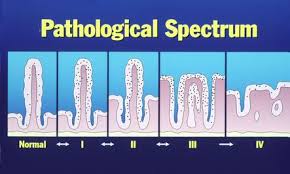
When Gluten is broken down in Celiac sufferers, it will bind to protein-binding enzymes that will change the shape of the gliadin peptides and present this changed peptide to the immune system. Because the peptide has undergone a conformational change, the immune system cannot recognize it and initiates an autoimmune response. Inflammatory signals are released and immune cells flood the area, damaging the lining of the small intestine and, in turn, decreasing the absorptive ability of the small intestine. This causes a host of malabsorptive-related issues such as "greasy" stools, anemia, a severe skin rash called dermatitis herpetiformis, bone density issues, and in young children, stunted growth. Yet many people with Celiac Disease do not show such severe symptoms; simple skin-rashes or outbreaks can manifest in response to gluten, or even just a feeling of being bloated or especially gasy are known to be signs of a gluten intolerance. Only around 5-10% of people actually get a medical diagnosis via blood test.
The problem arises when people who are not Celiac sufferers cut gluten out of their diet. Gluten containing products are a huge source of important carbohydrates, proteins, iron, and a host of other vitamins and minerals. This is especially a problem for vegetarians or vegans and athletes. Vegetarians and vegans need the gluten-containing foods because they are such good sources of vital vitamins and minerals, especially irons and the B vitamins which form the heme component of red blood cells. Anemia is a huge risk for gluten-free vegans and vegetarians because a lot of the foods with perceived high levels of iron (spinach, parsley, apricots) are not actually bioavailable; it is locked away in plant particles that our body has no way of digesting.
"But wait," you cry. "How is it that all these people still claim to lose weight or feel great after going gluten free?" This is actually quite simple. In our western society, it just so happens that a lot of the highly processed, starchy foods that everyone loves to eat with their fast food meals usually have gluten in them. By cutting out gluten, most people are cutting out foods that are also high in manufactured trans- and saturated fats which also are a huge component and cause of the inflammatory response. It has less to do with gluten than it does with simply eating a better diet.

The same goes for athletes. Athletes can greatly hurt themselves by trying to cut out gluten from their diet because athletes are usually eating healthy to begin with. Cutting out a healthy part of their diet by not having some gluten-containing food can not only cause their athletic performance to suffer, but can pose a health risk in the long run because of the lack of important nutrients in these gluten containing foods.
In short, unless you are suffering from Celiac Disease, you probably don't need to cut gluten out of your diet. You just have to watch what you eat. There are plenty of healthy foods that contain gluten such as couscous, whole grain breads and cereals, whole grain pasta, as well as a host of other unprocessed products, just as there are unhealthy foods that contain gluten. You just have to be smart about it.


